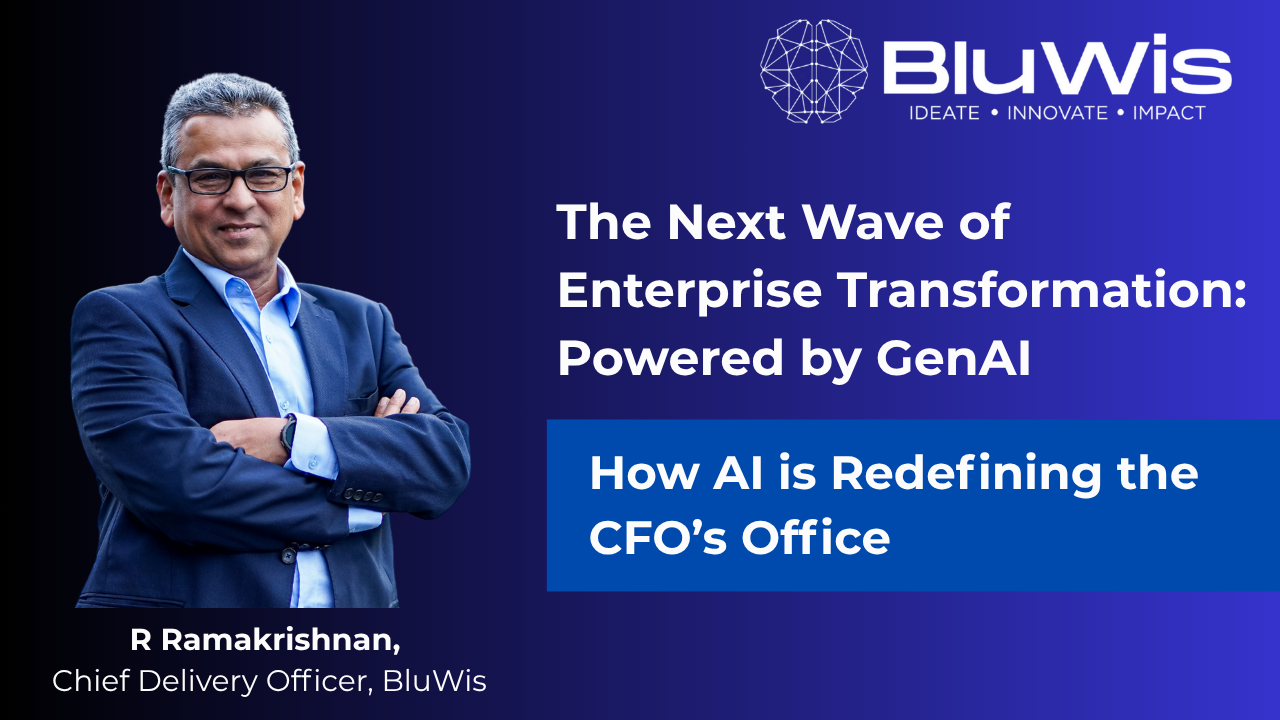
Every era of Enterprise Information Technology brought its own revolution, its own new wave that reshaped how organizations thought, operated and delivered value.
From the early days of mainframes that centralized control to the client–server architecture that democratized computing to the internet, mobile and cloud that connected people, things and information across the world, each wave has reflected a deeper truth: technology moves in waves of disruption and renewal.
Today we are riding a powerful wave called Artificial Intelligence (AI) and its more evolved sibling, Generative AI (GenAI).
From Computation to Intelligent Systems
Unlike the earlier transformations that were system-driven or built better databases, faster networks, smarter applications, the AI wave is intelligence-driven. It is about systems that learn, adapt, and reason and that can take on cognitive, judgment-based, and even some creative tasks once exclusively reserved for humans.
This wave goes way beyond automation or increased efficiency and productivity. It is about augmenting human capability by systems which have the capability to learn, adapt, reason, cognize, make judgements and even generate and create – tasks that were seen to be the preserve of humans.
The topic of AI and GenAI is a very wide and deep and I have chosen a small area to understand it’s impact in the Enterprise Applications space – the CFO’s office.
Why the CFO’s Office Matters
From ERP Implementations to Business Analytics to Shared Services to Automation, Finance leaders have historically driven technology-led transformations in most organizations. The CFO’s office is where enterprise data converges and where that data transforms into insight and foresight – key to strategic decision-making.
Now, with the emergence of AI and GenAI-powered and with SAP coming up with ready to use tools like Joule, finance leaders have an opportunity to take Enterprise IT to the next level.
Understanding the Technology
Traditional AI brings in two key capabilities to the table:
· Pattern Recognition: Identifying trends, patterns and even anomalies across massive datasets using algorithms and rules.
· Natural Language Intelligence: The foundation capability of GenAI which enables systems to understand and respond in human language.
GenAI, however, takes this further
· Cognition: Learning and reasoning through vast datasets and understanding context, not just correlation.
· Content Generation: Ability of a system to create (or generate) new original content such as Text, Image, Audio, Video or even Software Code based on what it has learnt.
CFO Use Case Examples: Let’s look at the new enhanced possibilities through the above stated capabilities.
· Automation of Routine Tasks
o Complex reconciliation tasks which typically involve humans to eyeball large volumes of data coming in from diverse sources in varied formats.
o Automatic alerts for transmission of critical information on pre-defined changes in select public websites
o Market & Competitive Monitoring: Automatic alerts related to competitive activity, commodity prices, exchange rates and similar activities or create alerts involving a combination of the factors mentioned above.
o Narrative Reporting – Use GenAI capabilities to generate an easy-to-understand commentary based on the interpretation of financial results.
· Enhanced Decision Making through Insights
o Scenario and Response Planning - Conduct advanced Forecasting & Budgeting by going beyond the traditional static modelling to dynamic planning and what-if scenario using more current data coming in from multiple sources. A great use-case for that can be used in planning – Working Capital, CAPEX, OPEX and any other category of costs or revenue.
o Data Driven Insights – The holy grail of all CFO is now a distinct possibility. Generating narratives that are easy and simple to understand from vast amounts of data for a wide variety of business users enabling them to take quick and informed decisions.
· Finance-as-a-Service Transformation
o Create more efficient service models for non-finance users offering valuable new and innovative services to business users.
o Enhance Service by offering “Ask Service” whereby users can use simple English to query the AI system and get data driven insights in the desired format
o Move valuable resources from routine manual functions to more evolved and enriching tasks.
· Risk Management & Compliance
o Move from post-facto audit to a proactive approach by processing large volumes of real-time data to flag anomalies to high-risk transactions.
o Generate a wide variety of Draft Reports for Statutory & Regulatory Compliance from multiple data sources using the generation capabilities of GenAI.
These use cases have the potential to transforms the CFO’s Office into a strategic command centre for the enterprise.
Implementation Challenges: Like for any innovative technology adoption, AI& GenAI adoption call for an approach that is a fine balance between “Enthusiasm & Experimentation” and “Caution & Diligence” at the other end. Below are 4 important guidelines for an approach that will ensure this balance.
The BluWis Perspective: Leading with Purpose
At BluWis , we believe that successful AI and GenAI adoptions are as much about how advanced technology as it is about how it is incubated, implemented and adopted. To ensure that AI delivers measurable business value, we recommend four guiding principles:
1. “Start with Use Cases, Not Buzzwords” Stay focused on solving Real Business Problems rather than Technology. Encourage business users to define ‘why’ before diving into the ‘how’.
2. “Horses for Courses”; Choose the Right Technology for the Right Problem. Not every challenge need GenAI. Automation. Sometimes simple automation or analytics may deliver a better ROI.
3. “Let a Thousand Flowers Bloom” Create an environment for experimentation. Investment Governance is Key. And lastly, more important that “Proof of Concept” is “Proof of Value”. Governance should guide investment decisions after proof of value, not before.
4. “Fail Faster to Succeed Sooner” – Pilot Before Scaling Up. Build MVPs, validate outcomes, and scale what works. The path to transformation is paved with agile learning.
At BluWis, we help CFOs operationalize these principles within the SAP ecosystem by integrating AI and GenAI across S/4HANA, BTP, SAC and Joule so that finance functions not only transform but also lead enterprise-wide value realization.
The Future: From Insight to Foresight
The CFO’s office has always been the north star of the enterprise and ensures control, compliance, and clarity. But in the GenAI era, it has the potential to do more: to predict, to guide, and to create.
With SAP's AI-embedded applications and BluWis' purpose-led transformation framework, finance leaders can now move from insight to foresight, from reactive reporting to proactive orchestration.
Every technology wave redefines what’s possible when organizations surf it with intent. The question is no longer if AI will transform finance but how purposefully we choose to lead that transformation.
Let us implement SAP AI-embedded applications in your organization together.
Warm regards,
R Ramakrishnan
Chief Delivery Officer, BluWis
You can reach Team BluWis via email: sales@bluwis.com