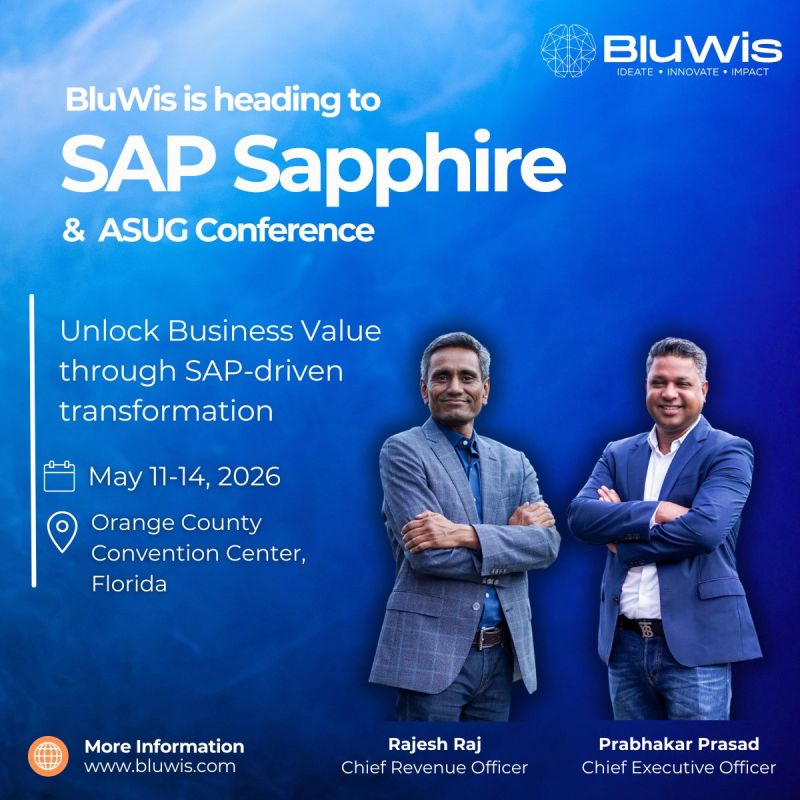
BluWis at SAP Sapphire & ASUG Annual Conference 2026
Driving Intelligent, Outcome-Led Enterprise Transformation
SAP Sapphire 2026 is where the future of enterprise technology, AI-driven operations, and SAP innovation comes together.
BluWis is excited to be part of this global gathering, joining enterprise leaders, architects, technology executives, and transformation strategists who are shaping the next era of intelligent business operations.
📍 Location: Orlando, Florida
📅 Dates: May 11–14, 2026 (In-Person)
As organizations prepare for SAP Sapphire 2026, the focus is shifting from technology adoption to measurable enterprise outcomes.
As SAP continues to advance its AI-first vision through innovations in enterprise AI, automation, cloud technologies, and intelligent business applications, the industry conversation is rapidly evolving.
Enterprise transformation is no longer defined only by successful implementation or technical modernization. Organizations are increasingly asking a more important question:
How can technology investments translate into measurable, sustainable business outcomes?
This shift requires enterprises to think beyond individual tools, platforms, and implementation milestones. It requires stronger alignment between business strategy, enterprise architecture, governance, data, and emerging AI capabilities.
At BluWis Technologies, we are leaning into that transformation.
Our conversations at SAP Sapphire & ASUG Annual Conference 2026 will focus on how organizations can build SAP environments that are not only modern, but also resilient, connected, AI-ready, and designed to deliver long-term business value.
What We’re Discussing at SAP Sapphire 2026
Our conversations at SAP Sapphire 2026 will focus on the architectural and operational decisions that define long-term enterprise success.
As organizations accelerate SAP modernization, the challenge is no longer simply moving from one technology environment to another. Enterprises must make decisions that influence how effectively they can innovate, integrate emerging technologies, manage complexity, and respond to changing business requirements.
From early transformation decisions and Clean Core strategy to integrated toolchains and AI-enabled operations, we believe the next era of SAP transformation will be defined by how effectively enterprises connect technology investments to measurable business outcomes.
Four areas are becoming particularly important: shifting critical decisions earlier in the transformation lifecycle, establishing a scalable Clean Core strategy, connecting fragmented enterprise toolchains, and applying AI where it can create measurable operational value.
Why “Shift Left” Decisions Define Transformation Outcomes
Successful SAP programs are increasingly determined by decisions made early in the transformation lifecycle.
These decisions include:
- Architecture alignment
- Governance frameworks
- Process rationalization
- Data strategy
- Clean Core planning
When these areas are addressed too late, organizations can face growing complexity, technical debt, integration challenges, and costly rework.
A shift-left approach brings critical architectural, governance, security, testing, and process decisions forward. Instead of waiting for issues to emerge during later stages of implementation, organizations establish the right foundations earlier.
This can help transformation teams identify risks sooner, improve alignment between business and technology stakeholders, and reduce downstream disruption.
For enterprise transformation leaders, shifting left is not simply a delivery methodology. It is a way to improve decision quality across the transformation lifecycle.
Organizations that make critical decisions earlier can create stronger foundations for scalability, adaptability, and long-term business agility.
One of the key conversations we look forward to exploring at SAP Sapphire 2026 is how earlier architectural and governance decisions can shape transformation outcomes.
By moving critical decisions upstream, enterprises can create greater clarity before complexity becomes embedded in the transformation program.
Why SAP BTP and Clean Core Are Becoming Business Imperatives
Modern enterprises can no longer sustain continuous innovation through heavily customized ERP cores.
For years, organizations added customizations to address specific operational requirements. While these modifications often solved immediate business needs, they also created increasingly complex environments that became difficult to upgrade, maintain, and modernize.
Today, enterprises need a different approach.
Through SAP Business Technology Platform (SAP BTP) and Clean Core strategies, organizations are building:
- Modular enterprise architectures
- Scalable innovation models
- AI-ready SAP environments
- Resilient transformation foundations
- More adaptable integration landscapes
A Clean Core approach enables organizations to protect the stability of their ERP foundation while creating room for innovation through extensions, integrations, automation, and emerging AI capabilities.
This is becoming increasingly important as the pace of enterprise technology change accelerates.
Organizations need the flexibility to adopt new capabilities without repeatedly introducing complexity into the core ERP environment. SAP BTP can provide an extensibility and integration foundation that allows innovation to happen while supporting the principles of a cleaner, more maintainable core.
The future of SAP transformation depends on balancing agility with architectural discipline.
For enterprise leaders, Clean Core is therefore becoming more than a technical objective. It is a strategic business consideration that can influence upgradeability, innovation speed, operational resilience, and long-term transformation costs.
At SAP Sapphire 2026, Clean Core and SAP BTP will remain central to conversations about building scalable, adaptable, and future-ready enterprise environments.
The challenge for organizations is not simply adopting new technologies. It is creating an architecture that allows innovation to continue without rebuilding complexity inside the core.
Breaking Enterprise Silos Through Integrated Toolchains
Disconnected transformation programs create disconnected business outcomes.
Large SAP transformation programs often involve multiple teams, platforms, partners, and governance structures. Architecture may be managed in one system, testing in another, security in a separate workflow, and project decisions across multiple disconnected tools.
The result can be fragmented visibility.
At BluWis, we are actively discussing how integrated enterprise toolchains—including:
- Tricentis
- LeanIX
- SAP security frameworks
- SAP Cloud ALM and lifecycle management platforms
can help organizations:
- Unify transformation governance
- Improve operational visibility
- Reduce enterprise silos
- Accelerate intelligent decision-making
- Strengthen traceability across transformation activities
- Drive more connected SAP transformation programs
When architecture, testing, security, governance, and lifecycle management operate in isolation, transformation teams can struggle to understand how decisions in one area affect the broader enterprise landscape.
For example, an architectural change may create new testing requirements. A process redesign may introduce security implications. A technical customization may affect future upgradeability.
Without connected visibility, these dependencies can be difficult to manage.
Integrated toolchains can help create a more connected transformation environment—one where teams have greater visibility into dependencies, risks, decisions, and business outcomes.
The goal is not simply to connect more tools.
It is to connect the information, decisions, and governance structures required to manage enterprise transformation more effectively.
As transformation ecosystems become more complex, SAP Sapphire 2026 provides an important forum for discussing how connected toolchains can improve visibility, traceability, and governance across enterprise transformation programs.
Where AI Can Truly Accelerate Business Value
AI adoption is rapidly expanding across enterprise landscapes.
Organizations are exploring Generative AI, intelligent automation, AI agents, predictive capabilities, and increasingly autonomous workflows.
But the real opportunity lies beyond experimentation.
Enterprise leaders are increasingly focused on:
- Measurable operational impact
- AI-enabled business outcomes
- Intelligent process orchestration
- Transformation acceleration
- Enterprise-wide decision intelligence
- Greater productivity across business and technology teams
The question is shifting from “What can AI do?” to “Where can AI create measurable enterprise value?”
At BluWis, we believe AI creates the greatest value when combined with:
- Strong architecture
- Clean Core discipline
- Operational governance
- Trusted enterprise data
- Business process context
AI can accelerate execution, analysis, documentation, testing, decision support, and process improvement.
However, sustainable enterprise value requires the right architectural and governance foundations.
Without enterprise context, AI may generate outputs that are technically possible but operationally unsuitable. Without governance, organizations may struggle to manage risk, security, accountability, and decision boundaries.
This is why AI strategy cannot exist separately from enterprise transformation strategy.
The AI conversation at SAP Sapphire 2026 is expected to move beyond experimentation toward practical applications and measurable enterprise value.
The focus must move beyond what AI can generate toward what AI can meaningfully improve across business operations.
The organizations that create the greatest value from AI will likely be those that combine technological acceleration with strong architectural discipline, trusted enterprise context, and clear business outcomes.
From Technical Modernization to Intelligent Enterprise Operations
SAP transformation is increasingly becoming part of a broader enterprise operating model.
Moving to a modern technology environment is important, but modernization alone does not guarantee better business outcomes.
Organizations must also consider how technology enables:
- Faster decision-making
- Greater operational visibility
- More connected business processes
- Improved enterprise resilience
- Continuous innovation
- Scalable AI adoption
This requires transformation programs to move beyond a project mindset.
Instead of viewing SAP modernization as a one-time implementation, enterprises can build foundations that support continuous improvement and adaptation.
The future-ready enterprise is not simply one that has implemented modern technology.
It is one that can continuously evolve as business models, customer expectations, regulatory requirements, and technology capabilities change.
This shift from technical modernization to intelligent enterprise operations will be an important part of the broader conversation at SAP Sapphire 2026.
That is the transformation conversation BluWis is bringing to Orlando.
Meet the BluWis Leadership Team in Orlando
Our leadership team will be on-site throughout SAP Sapphire 2026, engaging with enterprise leaders on how organizations can move:
- From execution to outcomes
- From fragmented programs to connected transformation
- From technical modernization to intelligent enterprise operations
- From isolated AI experiments to scalable enterprise value
We look forward to exchanging perspectives with business leaders, enterprise architects, SAP professionals, and transformation teams navigating the next phase of enterprise modernization.
These conversations are not only about technology.
They are about the decisions organizations must make today to create more resilient, adaptable, and intelligent enterprises for the future.
If you are attending SAP Sapphire & ASUG Annual Conference 2026 in Orlando, we would welcome the opportunity to exchange perspectives and discuss what future-ready SAP transformation should look like in the AI era.
Key Takeaways
- SAP transformation is becoming increasingly AI-driven and outcome-focused.
- Clean Core and SAP BTP are becoming strategic business priorities.
- Integrated toolchains can help reduce enterprise silos and improve transformation visibility.
- Shift-left transformation strategies can reduce long-term complexity and downstream risk.
- AI creates the greatest value when paired with strong governance, architecture, trusted data, and enterprise context.
- Future-ready SAP transformation requires organizations to connect technology modernization with measurable business outcomes.
Let’s Connect at SAP Sapphire 2026
The next era of enterprise transformation will require more than technology implementation.
It will require connected thinking across architecture, governance, data, AI, business processes, and enterprise operations.
For BluWis, SAP Sapphire 2026 is an opportunity to connect these conversations around architecture, AI, governance, Clean Core, and measurable business outcomes.
At BluWis, we are focused on helping organizations navigate this complexity and build transformation foundations designed for long-term resilience and intelligent growth.
Connect with BluWis in Orlando to discuss intelligent enterprise transformation, AI-led modernization, Clean Core strategy, integrated toolchains, and future-ready SAP architectures.
Let’s explore how your organization can move from technical execution to measurable enterprise outcomes.
Book a Meeting: